

Choosing the right projector is the very first decision you make when planning any HID retrofit, and it is one that trips up a lot of people before they ever pick up a tool. When we sit down to plan a build, the question we always answer first is whether the car needs a low beam projector or a bi-xenon projector. Getting this wrong can cost you your high beam function entirely, so understanding the difference between bi-xenon projectors vs low beam projectors is worth a few minutes of your time before you spend a dime on parts. In this guide we walk through exactly how we make that call, using a Lexus RX and an Acura TL as our physical examples.
Start With Your Factory Bulb Setup
The first step in choosing parts for a retrofit is deciding whether you are going to use a low beam projector or a bi-xenon projector. What you have to consider in picking that out is whether or not your car uses two separate bulbs for the low and the high beam, or a single dual filament bulb that handles both. This one detail dictates everything that follows, so before you look at any lens diameter or shroud style, pop your headlight open and figure out what bulb setup you are working with.
If you have something like a 9005 and a 9006 (one bulb for your low beam and one for your high beam), you have options. If your car uses a single bulb like an H4, a 9004, or a 9007 that carries two filaments inside one housing, your options narrow down quickly. We will break down both scenarios below so you can identify where your vehicle lands.
Two Separate Bulbs (9005 and 9006)
When a vehicle uses two separate bulbs for the low and high beam, you have the freedom to go either direction. You can use a dedicated low beam projector, like the one found on this Lexus RX, or you can use a bi-xenon projector like the Acura TL unit we brought to the bench. Because the factory high beam is handled by its own separate bulb and reflector, you are not obligated to make the projector do double duty. A lot of builders in this situation still choose a bi-xenon so they get a crisp projector-based high beam, but a dedicated HID low beam projector remains a perfectly valid path.
A Single Dual Filament Bulb (H4, 9004, 9007)
If your car uses a single dual filament bulb, the decision is made for you. You have to use a bi-xenon projector so that you can retain the full functionality of your low and your high beam. If you do not use a bi-xenon in this situation, you are going to lose your high beam function after the retrofit. That is the trap we see people fall into: they buy a low beam only projector, install it into a single bulb car, and then discover their high beams no longer work. A bi-xenon HID projector is the only way to keep both beams alive from a single dual filament setup.

How a Low Beam Projector Works
A low beam projector is the simpler of the two designs. It has a single cutoff shield that is fixed in place, and that fixed shield creates one low beam pattern. There is no ability to change between low and high beam with this style of projector. Whatever beam pattern the fixed shield produces is the only beam pattern you get. That is not a flaw, it is simply the intended function, and in a two-bulb car the separate high beam bulb picks up where the projector leaves off.

When we inspected the Lexus RX projector on the bench, this fixed shield is exactly what we saw. It sits stationary, it shapes the light coming out of the lens into a defined cutoff, and it never moves. That is the entire mechanism. Simplicity like this can be a benefit if your car already has a dedicated high beam bulb, because there are fewer moving parts to worry about over the life of the light.
How a Bi-Xenon Projector Works
A bi-xenon projector is where things get interesting. Instead of a fixed shield, you actually have a shield that creates the beam pattern and is mounted on a hinge. This hinge is the key to the whole design. When power is inputted to the solenoid, the hinge and the shield move forward or down out of the way to expose more light for the high beam. So the shield is not just a static piece of metal, it is an active part that swings out of the light path on command.

To demonstrate this, we hooked the Acura TL bi-xenon up to a power supply. When power is applied, the shield moves out of the way, and again you get your high beam out of the lens. It is a satisfying thing to watch on the bench, because you can see the mechanical action of the solenoid pulling the shield down and immediately opening up the beam. If you ever want to see the physical hardware that makes this happen up close, take a look at a retrofit projector shield to understand how the hinge and cutoff are shaped.

One Bulb Does Both Jobs
Here is the point that clears up the most confusion for people new to retrofits: all of it uses the same single bulb inside the reflector bowl. There is no change with the bulb between low and high beam in a bi-xenon projector. The bulb stays lit and stationary, and the only thing that changes is the position of the shield. Low beam is the shield in its resting position shaping the cutoff, and high beam is that same shield swung out of the way to release more light. That is why a bi-xenon can retain both beam functions from a single dual filament bulb setup, because the projector itself provides the mechanism the factory bulb used to provide with its two filaments.
Seeing the Difference on the Wall
To understand how a bi-xenon projector works a little bit more, we reassembled the TL bi-xenon unit so we could show the difference between the low and the high beam on a wall. Watching it on the bench and watching it project against a flat surface are two different experiences. On the wall, you can clearly see the tidy low beam cutoff, and then as power hits the solenoid, that cutoff line lifts and the pattern fills in above it for the high beam.

This is the demonstration that ties everything together. Two projectors, two different mechanisms, and one clear takeaway: the low beam unit gives you a single fixed pattern, while the bi-xenon unit uses a moving shield to serve both duties from one bulb. If you are still shopping around and comparing options for a full build, it never hurts to browse a wider range of hid lights to see how different projectors are packaged for different vehicles.
Quick Buyer’s Recap
Let us boil it all down so you can walk away with a clear decision framework. First, identify whether your car uses two separate bulbs or a single dual filament bulb. If it uses two bulbs like a 9005 and 9006, you can choose either a dedicated low beam projector or a bi-xenon projector based on your preference. If it uses a single bulb like an H4, 9004, or 9007, you must use a bi-xenon projector to keep both low and high beam. Second, remember that a low beam projector has one fixed shield and one pattern, while a bi-xenon has a hinged shield driven by a solenoid. Third, know that a bi-xenon uses the same single bulb for both beams, with the shield doing all the work of switching between them.
That is the entire logic behind the choice. When we plan a retrofit at the bench, we run through these exact checkpoints every single time, and it keeps us from ever accidentally deleting a customer’s high beam. Match the projector to your bulb setup first, and the rest of the build gets a whole lot easier.
Frequently Asked Questions
How do I know if I need a bi-xenon projector instead of a low beam projector?
It depends on your factory bulb setup. If your car uses two separate bulbs for low and high beam, like a 9005 and 9006, you can choose either a dedicated low beam projector or a bi-xenon projector. If your car uses a single dual filament bulb, like an H4, 9004, or 9007, you must use a bi-xenon projector to keep both low and high beam function.
What happens if I use a low beam projector with a single bulb setup?
According to the explanation, if your car uses a single dual filament bulb and you install a low beam only projector, you will lose your high beam function after the retrofit.
How does a low beam projector work?
A low beam projector has a single, fixed cutoff shield that creates one beam pattern. There is no mechanism to switch between low and high beam.
How does a bi-xenon projector switch between low and high beam?
A bi-xenon projector has a shield mounted on a hinge connected to a solenoid. When power is applied to the solenoid, the hinge and shield move forward or down out of the way, exposing more light for the high beam. The same single bulb inside the reflector bowl is used for both beams, so there is no bulb change between low and high.
What vehicles were used to demonstrate these projector types?
The demonstration used a Lexus RX as an example of a dedicated low beam projector and an Acura TL as an example of a bi-xenon projector, reassembling the TL bi-xenon unit to show the beam difference on a wall.
Meet the Experts Behind The Retrofit Source
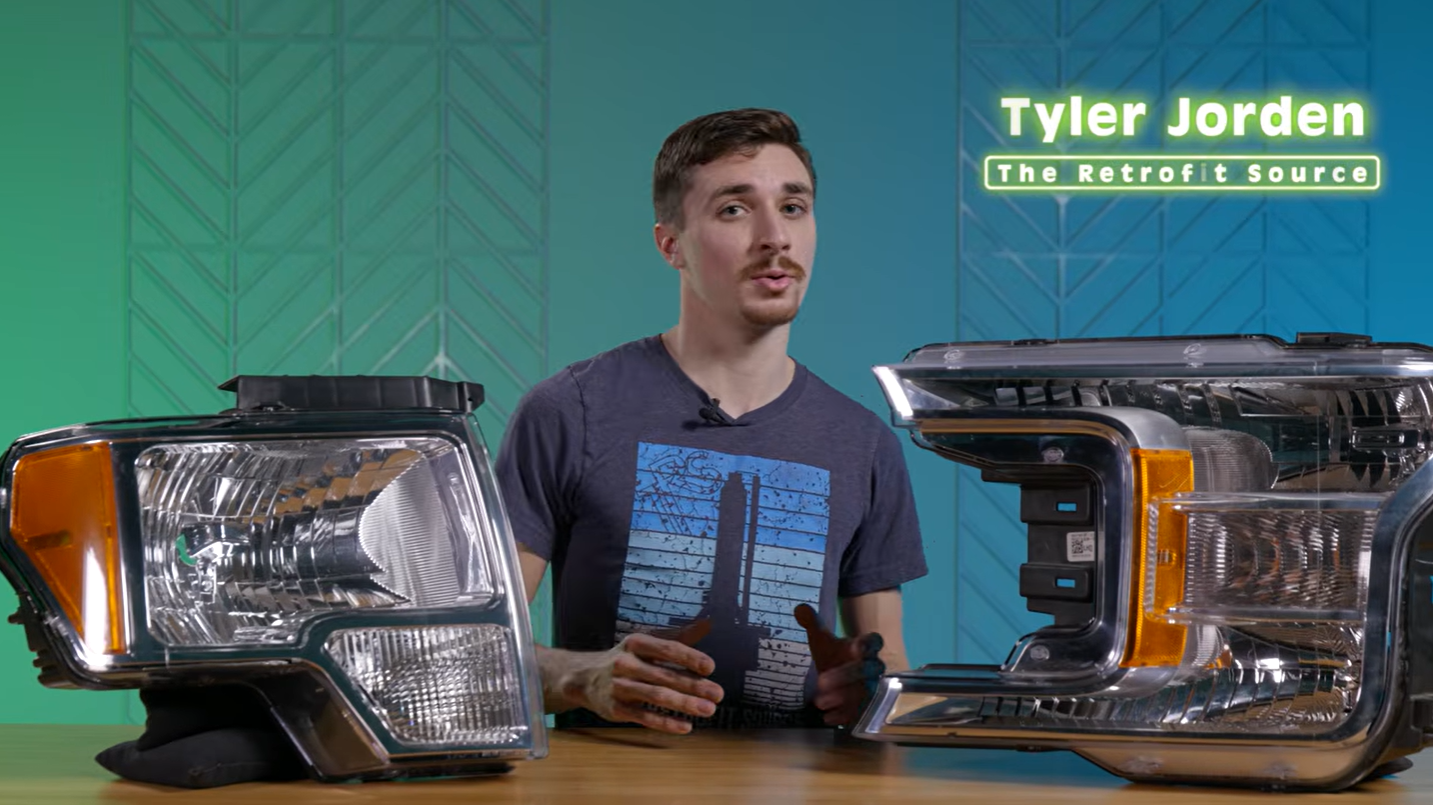
Tyler Jordan – Technical Writer
Tyler works directly with the TRS product R&D team, bringing over a decade of automotive aftermarket lighting experience to every article. An avid enthusiast with hundreds of personal installations under his belt, his content is built on hands-on knowledge from the workbench, not spec sheets.

Caleb Morgan – Marketing Manager
Caleb brings over a decade of automotive lighting industry experience and works with TRS customers daily on the front lines. With hundreds of personal lighting installations and a direct feedback loop from real buyers, his content addresses the questions and problems that actually matter.


